
Vatican City
I was present yesterday at the Vatican when His Holiness, Pope Francis,
closed the Fourth Annual Congress of Scholas
Occurrentes—a project personally supported by the Pontiff and directed by
José María del Corral and Enrique Palmeyro, the underlying mission of which is
the achievement of world peace through education—with a worldwide call for “reconstruction
of the educational pact.”
 |
At the closing ceremony of the Scholas Congress,
I had the privilege of meeting Pope Francis and
presenting him with a copy of my book,
"El Crimen de la Guerra", soon to be published
in English as "War: A Crime Against Humanity".
Behind the Pope is Scholas Co-Director José
María del Corral.
|
The Pope posited that, for some time now, the educational pact that
should exist between learning centers, students, nations, cultures and society
as a whole “is broken...and badly broken, and it can’t be stuck back together.”
He issued a challenge to all principal players throughout the world “to
harmonize” so as to be able to change the course of education and of children
“who are the future.”
On closing the conference—attended by educators, social leaders,
renowned personalities who use their fame to back projects that aid
underprivileged children, and other people linked to peace education—Pope
Francis said that his great concern was that of “achieving harmonies.”
“Not simply achieving compromises, achieving deals, achieving partial
understandings,” he added. “Harmony is, in a sense, creating an understanding
of differences, accepting differences, valuing differences,” he continued. “We’re
not going to change the world if we don’t change education.”
He rendered tribute to teachers, warning that all other institutions in
society had “delegated education to the agents of education, to the
teachers...generally poorly paid teachers,” who had been forced to bear all of
the responsibility of educating the world’s children.
Regarding the fundamental mission of Scholas
Occurrentes, the Pontiff said: “Scholas
wants to reintegrate, somehow, the efforts of everyone in pro of education. I
want to rebuild, harmoniously, the educational pact.”
The Pope added that it was “for this reason that Scholas seeks bridges: culture, sports, science...Moreover, Scholas seeks to harmonize education in
the person of children themselves.” He added that, toward this end, “Scholas wants to harmonize the language
of the head with the language of the heart, and the language of the hands, so that
(children) think what they feel and feel what they do.”
He called on each nation in the world to reencounter “the foundational
things of the nation, that which make sense of that nation,” and to draw from
those things, “the kind of universality that harmonizes...foundational health,
a ludic capacity, the creative capacity of play.”
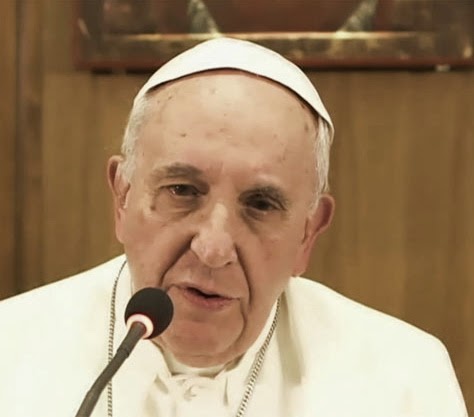 |
| Pope Francis: "achieving harmonies" |
The Pontiff kicked off the closing ceremony of the Scholas Occurrentes Congress by participating in a
video-conference with children suffering
from different mental and physical challenges, who explained how technology had
aided them in improving their quality of life. Following his dialogue with the
children, the Pope transmitted a personal message to them: “Each of you has...a
box with a treasure inside. Your job is to open the box, take the treasure out,
make it grow, and give that treasure to others, and receive the treasures that
the others share with you. Each one of us has a treasure inside. If we keep it
locked up, it just stays there closed up. If we share it with others, the
treasure multiplies with the treasures that come from others.”
Pope Francis concluded his closing presentation by expressing his wish
“that this spark that has been born might spread, in a fire that will help
reconstruct (and) harmonize the educational pact. The winners in this are the
kids, and I thank you all for what you are doing for the future, because saying
kids is the same as saying future.
Comments
Post a Comment